Ray tracing is one of the most significant revolutions to reshape graphics in gaming and design over the past few years, and NVIDIA has been the driving force that moved this technology from a heavy theoretical concept into something that runs in real time inside games. In this guide, we'll explain what ray tracing is, how it works inside NVIDIA RTX graphics cards, how it differs from traditional rendering, and where the technology stands as of 2026.
What Is Ray Tracing?
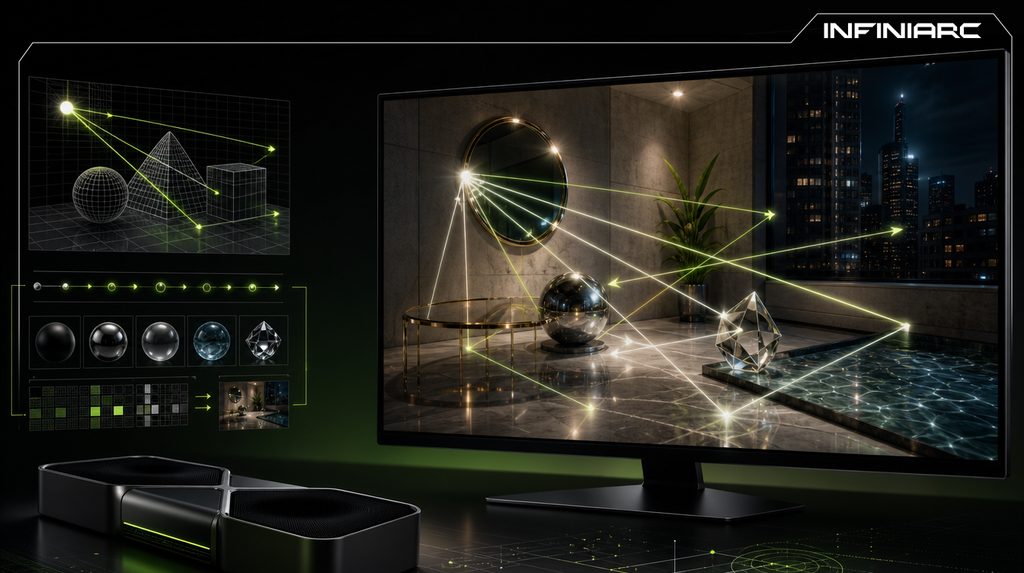
Ray tracing is a method of simulating how light behaves in the real world within a 3D scene. In reality, light travels from its source and bounces off surfaces before reaching our eyes, which is what gives us natural shadows, reflections, and illumination. Ray tracing mimics this process digitally, but in reverse: instead of tracing every ray from the source, the GPU casts a virtual ray for each pixel on screen starting from the viewer's perspective, then calculates where that ray hits objects and how it interacts with them in terms of color, reflection, and transparency.
The result is lighting, shadows, and reflections that look remarkably close to reality and change naturally as the viewing angle shifts, something that's difficult to achieve with traditional methods.
Ray Tracing vs. Traditional Rasterization
- Before real-time ray tracing existed, games relied on a technique called rasterization. This approach is fast and efficient, but it depends on tricks and approximations to draw shadows and reflections, such as shadow maps and screen-space reflections. The problem is that these tricks have limits: reflections, for example, can only show what's already inside the screen frame and disappear the moment the camera moves.
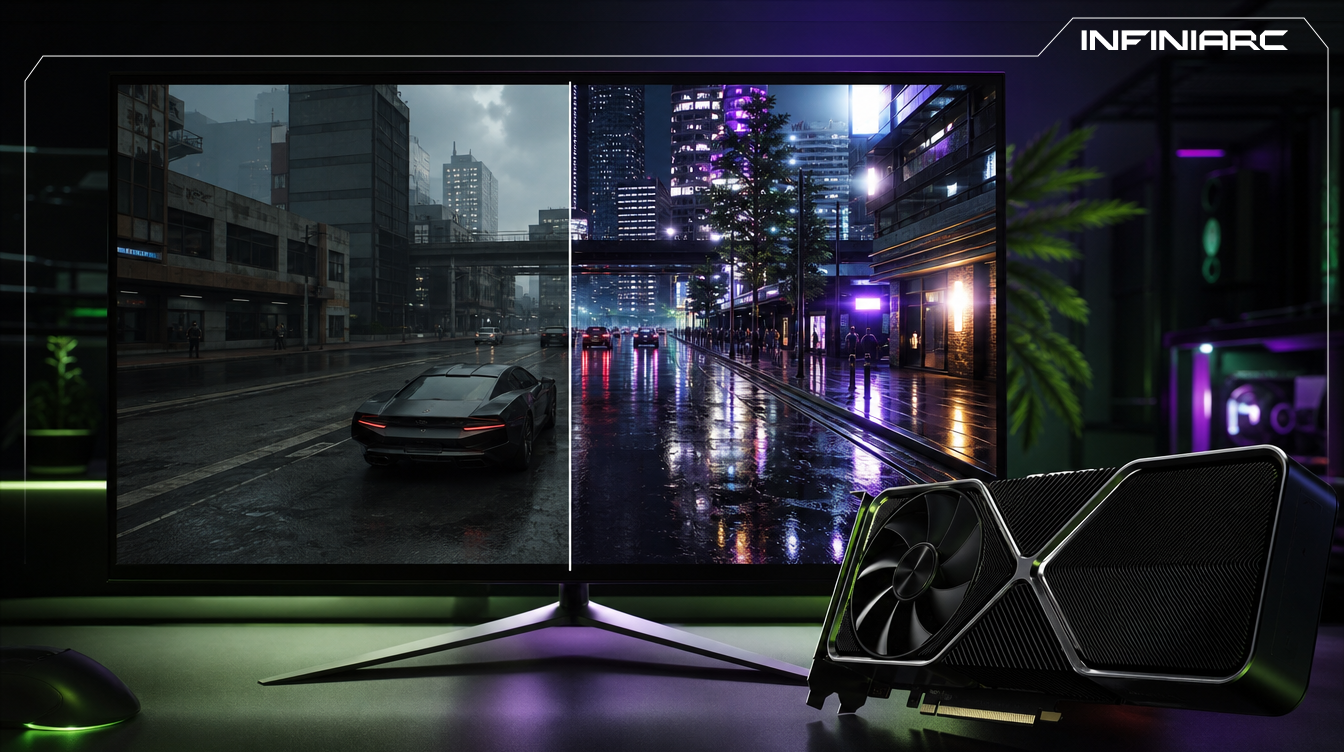
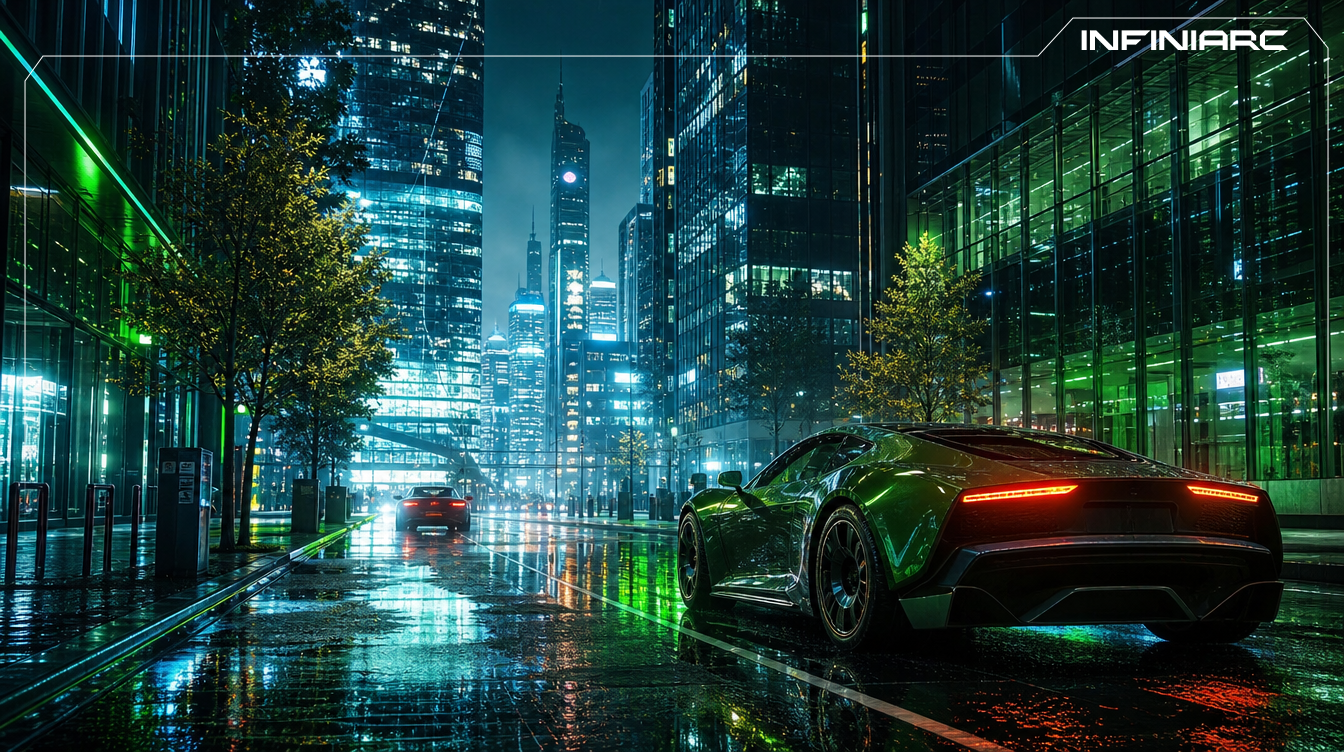
- Ray tracing, on the other hand, calculates lighting based on real physics. It produces accurate reflections in mirrors, glass, and puddles, soft graduated shadows, and global illumination that bounces between surfaces and carries color between them. The difference is most obvious in scenes involving metal, water, glass, or complex shadows.
How Ray Tracing Works Inside NVIDIA RTX Cards
NVIDIA's journey with real-time ray tracing began in 2018 with the GeForce RTX 20 series, built on the Turing architecture, with Shadow of the Tomb Raider among the first games to support it. The secret behind these cards' ability to run ray tracing in real time lies in specialized hardware components:
- RT Cores: Dedicated hardware units for calculating light paths and where rays intersect with objects. These cores are what set RTX cards apart from older GTX cards, which lacked them and therefore cannot run real-time ray tracing effectively.
- Tensor Cores: Specialized units for AI and math-heavy tasks, and the hardware that powers DLSS to boost performance and enhance image quality.
- CUDA Cores: The primary workers of the GPU that handle general graphics processing.
This intelligent division of labor is what allowed NVIDIA to solve the hardest challenge in real-time graphics: making light look real without sacrificing performance.
The Role of DLSS in Enabling Ray Tracing
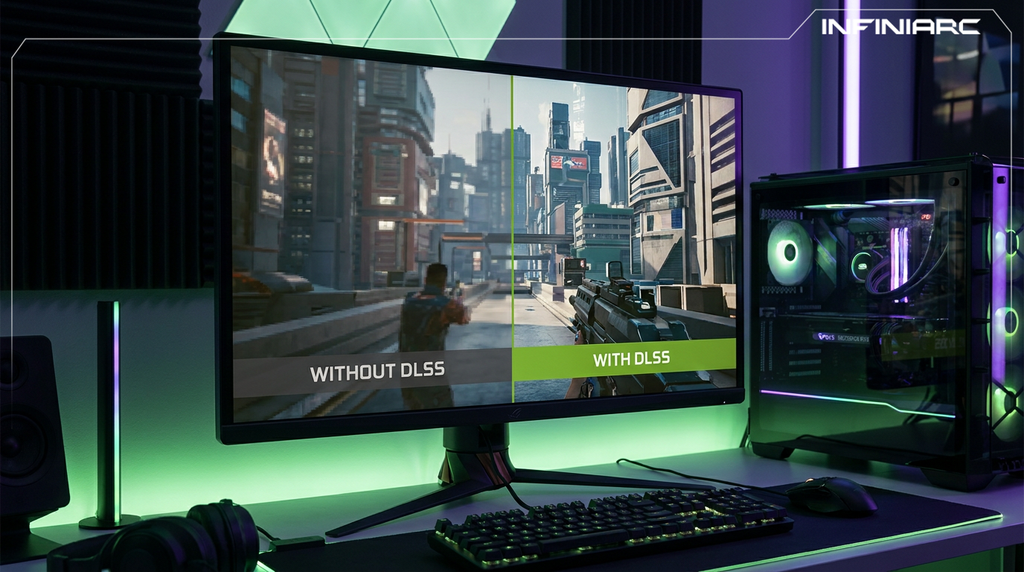
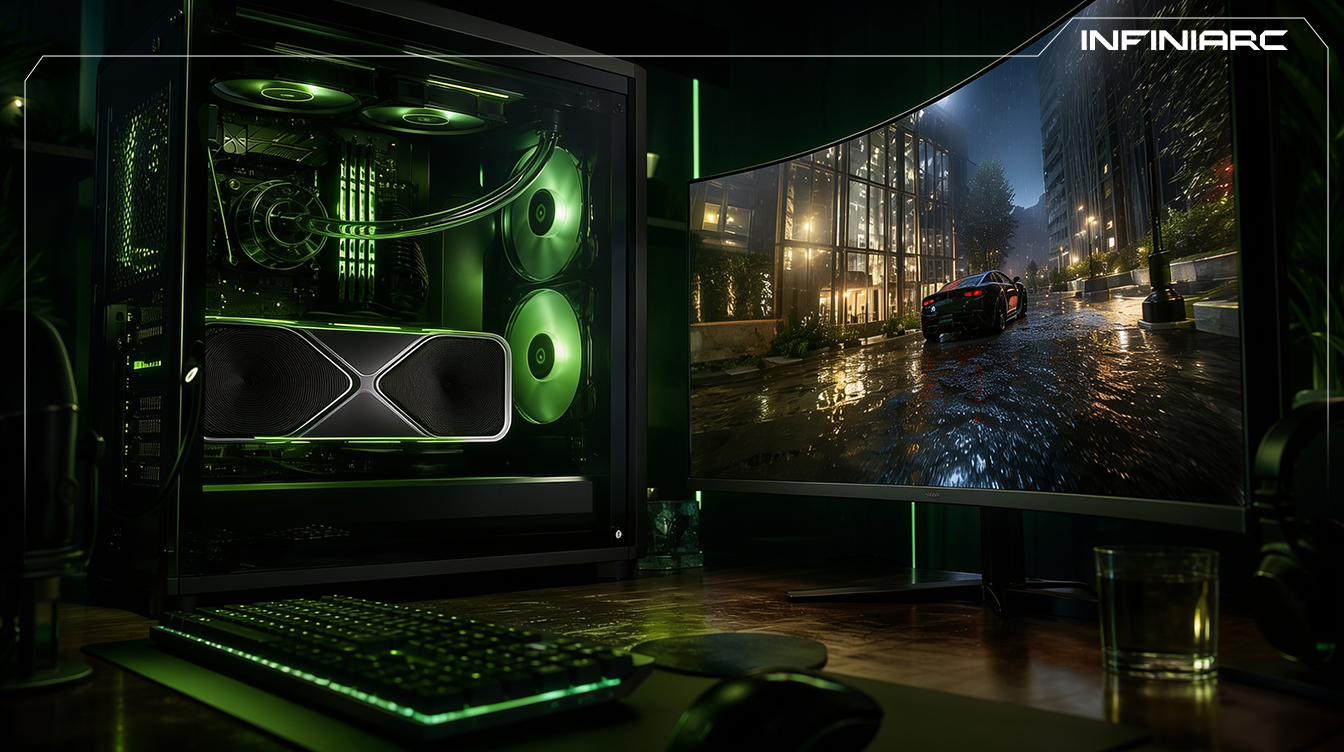
- Despite its visual beauty, ray tracing is extremely demanding and can cause a noticeable drop in frame rate (FPS). This is where NVIDIA's DLSS (Deep Learning Super Sampling) comes in, using AI to upscale the image virtually while maintaining a high frame rate.
- DLSS has evolved dramatically over time, reaching DLSS 4.5 by 2026, which NVIDIA announced at CES and COMPUTEX. Key features include Multi Frame Generation, capable of generating several AI frames for every rendered frame, along with Ray Reconstruction.
- Ray Reconstruction specifically addresses one of ray tracing's oldest problems: the grainy, noisy image produced when a GPU can only calculate a limited number of rays per frame. Instead of traditional hand-tuned denoisers, it uses an AI network trained on supercomputers to produce higher-quality pixels in the noisy parts of the scene. Importantly, this technology is available to all GeForce RTX cards, including the older RTX 20 and RTX 30 series, not just the latest models.
Path Tracing: The Next Step Forward
As cards became more powerful, the term path tracing emerged as a more comprehensive form of ray tracing. While standard ray tracing applies the technique to specific aspects of an image (such as reflections or shadows), path tracing simulates all lighting aspects of a scene at once, from global illumination to shadows, ambient occlusion, and reflections. This approach is far heavier and leans heavily on RT Core power and AI techniques to make up the performance difference.
Do You Really Need a Ray Tracing Card?
- The answer depends on your priorities. If you play modern games and care about maximum visual realism, an RTX card with ray tracing enabled gives you a much deeper visual experience. But if your main concern is the highest possible frame rate in competitive games, you may prefer to keep it off in favor of performance. The good news is that technologies like DLSS have dramatically narrowed this trade-off, making it possible to enjoy the beauty of ray tracing with acceptable performance.
- When choosing a ray-tracing-capable card in the 2026 market, keep an eye on a few specs: VRAM (ideally no less than 16GB for 4K gaming), the number of CUDA and RT cores, whether your power supply (PSU) can handle the card's draw, and a solid cooling system for long sessions.
Frequently Asked Questions About Ray Tracing on NVIDIA Cards
Do GTX cards support ray tracing?
- GTX cards lack dedicated RT Cores, so they cannot run real-time ray tracing effectively, though some can run it in software at very poor performance.
Does DLSS reduce image quality?
- When configured correctly, DLSS often makes the image look equal to or better than native resolution while significantly increasing the frame rate.
Is ray tracing worth enabling?
- In games with complex reflections and lighting, ray tracing delivers a clear visual difference that's worth trying, especially with DLSS support.
What's the difference between ray tracing and path tracing?
- Ray tracing applies to specific aspects of an image, while path tracing simulates all lighting aspects together, making it heavier and more realistic.
Conclusion
Ray tracing in NVIDIA RTX cards isn't just a graphics update, it's a paradigm shift in how light is simulated in a digital world. By combining the physical accuracy of RT Cores with the efficiency of AI through Tensor Cores and DLSS, NVIDIA has made realistic lighting possible without sacrificing performance. With over 1,000 games and apps supporting the technology today, and advances like DLSS 4.5 and Ray Reconstruction, the future of real-time graphics looks set to remain firmly built on ray tracing.